
In 2026, more people and businesses in India are talking about Net Zero. Many companies are now being asked questions like: “What are you doing about your emissions, ESG, and sustainability?” This is because climate change, government rules, and customer pressure are pushing businesses to act.
Net Zero does not mean shutting down or stopping all work. It means doing everything possible to cut greenhouse gas emissions and then balancing the rest with real‑world actions that remove or offset carbon. For Indian businesses, this is no longer just a good‑to‑have idea – it is slowly becoming part of how companies plan and grow.
India has also made clear climate promises under global agreements and national targets. Indian donors, investors, and customers are now watching which companies are serious about Net Zero, ESG, and sustainability.
2. What Does Net Zero Mean?
Definition of Net Zero
Net Zero means that the total amount of greenhouse gases a business releases into the air is balanced by the amount it removes or offsets. Put simply:
- If a company releases 100 units of CO₂,
- It must cut emissions as much as possible, and then remove or offset the leftover amount,
- So that the overall impact becomes zero.
This is not something that can be done overnight. It is a long‑term path that includes using cleaner energy, improving processes, and supporting projects that take carbon out of the air.
Reducing Emissions vs Eliminating Emissions
Many people mix up reducing emissions and eliminating emissions.
- Reducing emissions means using less fuel, saving energy, and switching to cleaner technology.
- Eliminating emissions completely is very hard for most businesses today.
- Net Zero allows companies to cut emissions as much as possible, and then balance the rest with real removal or offsetting.
Balancing Emissions Through Reduction and Carbon Removal
To move towards Net Zero, a business must:
- Cut emissions from its own operations and supply chain.
- Support carbon removal projects such as renewable energy, tree planting, and other climate‑friendly activities.
- Use good‑quality offsets where needed, not just low‑cost certificates with no real impact.
This balance has to be clear, honest, and based on real data, not just marketing.
Long‑Term Sustainability Goals
Net Zero is usually linked with longer‑term goals like:
- Cutting carbon from operations by 2040–2050.
- Moving more towards renewable energy over time.
- Reducing waste and using resources more carefully.
These goals help businesses stay ready for future rules, changing customer tastes, and global standards.
3. Why Net Zero Matters for Indian Businesses in 2026
Today, many investors are looking for companies that care about environment, people, and good governance – often called ESG. If a company shows clear Net Zero goals and real progress, it becomes more attractive to investors.
Indian donors and impact investors also prefer supporting businesses that:
- Try to reduce emissions,
- Share information on climate risks, and
- Have a clear sustainability plan.
You can read more about how to build a Net ZeroStrategy for your Indian business here
3.2 Customers Prefer Sustainable Brands
Indian customers are becoming more aware of climate change, pollution, and packaging waste. Many now like brands that:
- Use less plastic,
- Save energy, and
- Show real steps on Net Zero and ESG.
A business that talks about Net Zero for Indian businesses and backs it with action can build stronger trust and loyalty.
3.3 Government Regulations Are Increasing
Indian regulators are slowly tightening rules around climate and sustainability. For example:
- BRSR (Business Responsibility and Sustainability Reporting) requires many companies to share how they affect the environment, emissions, and climate risks.
- SEBI has brought clearer ESG and sustainability rules for listed companies.
- Carbon disclosure trends are making it easier for businesses to measure and report their emissions.
If a business is already working on Net Zero, it will find it easier to follow these rules and reduce the risk of penalties.You can learn about ESG Reporting for Indian businesses in more detail here:
3.4 Operational Cost Reduction
Moving towards Net Zero can also help cut costs.
- Improving energy efficiency brings down electricity bills.
- Using renewable energy reduces long‑term fuel costs.
- Better waste management lowers raw‑material and disposal costs.
In short, Net Zero is not only good for the planet, it can also support business growth.
4. Key Industries Moving Towards Net Zero in India
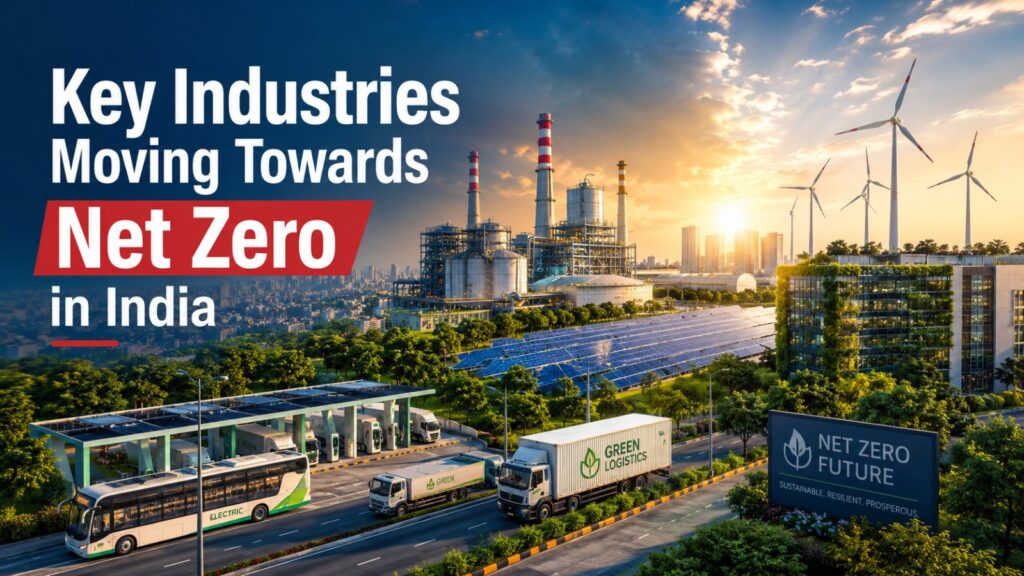
Many Indian sectors are starting to take steps on Net Zero:
- Manufacturing: Factories are switching to energy‑efficient machines, using waste heat, and adding solar power.
- Real Estate: Builders are designing green buildings, using less energy, and saving water.
- Infrastructure: Road, rail, and construction firms are using cleaner materials and more efficient transport.
- Textile: Companies are cutting water use, chemical waste, and using cleaner energy.
- FMCG (Fast‑Moving Consumer Goods): Brands are reducing plastic, using recycled materials, and improving logistics.
- Logistics: Transport companies are testing electric vehicles and using smarter routes to save fuel.
- Energy: Power companies are increasing renewable energy and making grids more efficient.
- Agriculture: Farmers and agri‑businesses are using lower‑emission methods and saving water.
These industries are slowly turning Net Zero for Indian businesses from a slogan into a real‑life plan.
5. Steps Businesses Can Take to Start Their Net Zero Journey
5.1 Measure Current Carbon Emissions
The first step is to measure your carbon footprint. This means:
- Collecting data on fuel, electricity, transport, and waste.
- Working out Scope 1, Scope 2, and Scope 3 emissions using widely accepted methods like the GHG Protocol.
You can understand Carbon Accounting simply and learn how to measure your business’s
Scope 1, Scope 2, and Scope 3 Emissions – Simple Explanation
Scope 1: Direct emissions from your own operations (for example, burning fuel in boilers or vehicles).
Scope 2: Emissions linked to the electricity you buy and use.
Scope 3: All other emissions connected to your business, such as suppliers and how customers use your products.
For Net Zero for Indian businesses, all three scopes matter.
5.2 Set Realistic Sustainability Goals
Once you know your emissions, set clear goals like:
- Reducing energy use by 20% in five years.
- Cutting emissions by 30% by 2030.
- Using 50% renewable energy by 2035.
These goals should be measurable and realistic, not just big promises.
5.3 Improve Energy Efficiency
Ways to improve energy efficiency include:
- Switching to LED lights and smart systems.
- Using energy‑efficient machines and better cooling systems.
- Installing solar panels or other renewable energy where possible.
You can also read more about how to build a Net Zero Strategy that includes energy‑saving steps here-Net Zero Strategy
5.4 Reduce Waste and Resource Consumption
Businesses can move towards circular economy practices by:
- Cutting down on single‑use materials.
- Recycling and re‑using waste.
- Designing products that last longer and create less waste.
You can discover Circular Economy ideas and simple ways to reduce waste here:
You can also explore Water Management and climate‑smart practices to cut water use and protect resources
5.5 Build ESG Reporting Systems
To stay trusted and follow rules, companies should build ESG reporting systems that:
- Collect data on emissions, water, waste, and social impact.
- Create clear, simple reports for investors and regulators.
- Follow guidelines like SEBI and BRSR.
You can learn about ESG Reporting for Indian businesses in more detail here:
You can also check Climate Risk and how to prepare your business for future climate‑related challenges here: Climate Risk
6. Common Challenges Businesses Face
Many Indian businesses want to act on Net Zero, but they face real problems:
- Lack of awareness: Many leaders do not fully understand Net Zero, Scope emissions, or ESG.
- Cost concerns: Installing solar panels, energy‑saving tech, or software can feel expensive at first.
- Data collection issues: Getting proper data from factories, suppliers, and offices can be difficult.
- Supply chain emissions: It is hard to control emissions from suppliers and transport partners.
- Sustainability implementation gaps: Some companies make plans but do not follow them properly in daily practice.
Overcoming these issues needs clear thinking, training, and small, steady steps.
7. Benefits of Achieving Net Zero
When a business moves towards Net Zero for Indian businesses, it can gain many benefits:
- Stronger brand reputation: Customers and donors trust companies that take the environment seriously.
- Better investor confidence: Investors prefer businesses that show clear ESG and climate action.
- Improved compliance readiness: Companies are better prepared for rules like BRSR and carbon reporting.
- Long‑term cost savings: Energy efficiency and renewable energy can cut bills over time.
- Competitive advantage: Sustainable brands stand out in crowded markets.
- Better global partnerships: International buyers and partners often prefer low‑carbon suppliers.
These benefits show that Net Zero is not only a cost, it can support long‑term business growth.
8. How Technology Is Helping Businesses Achieve Net Zero
New tools are making it easier for companies to track and manage Net Zero:
- Carbon accounting software: Helps businesses measure and track Scope 1, 2, and 3 emissions.
- ESG platforms: Collect data, create reports, and track progress on ESG and sustainability.
- AI and analytics: Can find hidden energy waste and suggest ways to save power.
- Energy monitoring systems: Show real‑time electricity use so mistakes can be fixed quickly.
- Sustainability dashboards: Give managers a clear view of emissions, costs, and progress.
You can understand Carbon Accounting simply and see how software can support your business here:
9. The Future of Net Zero in India
India has set clear climate targets, including:
- Lowering emissions intensity of the economy.
- Increasing the share of renewable energy.
- Supporting green manufacturing and cleaner transport.
In the coming years:
- The ESG ecosystem in India is expected to grow.
- Sustainable finance will likely increase, with more green loans and impact funds.
- Green manufacturing and low‑carbon projects may get more support.
- International buyers may expect Indian suppliers to follow Net Zero and ESG standards.
So, starting the journey now gives Indian businesses a useful head start.
10. Conclusion
Net Zero for Indian businesses is no longer optional in 2026. It is slowly becoming part of how companies plan, invest, and grow.
Businesses that act early can:
- Build stronger trust with customers and donors,
- Attract better investors,
- Stay ready for new rules, and
- Save money through energy and waste reduction.
Sustainability is now part of the core business plan, not just a side project. If you want clear, simple, and practical steps, your team at Asakamecoplanet can help you build a clear Net Zero strategy for your Indian business.You can read more about how to build a Net Zero Strategy here: